Introduction
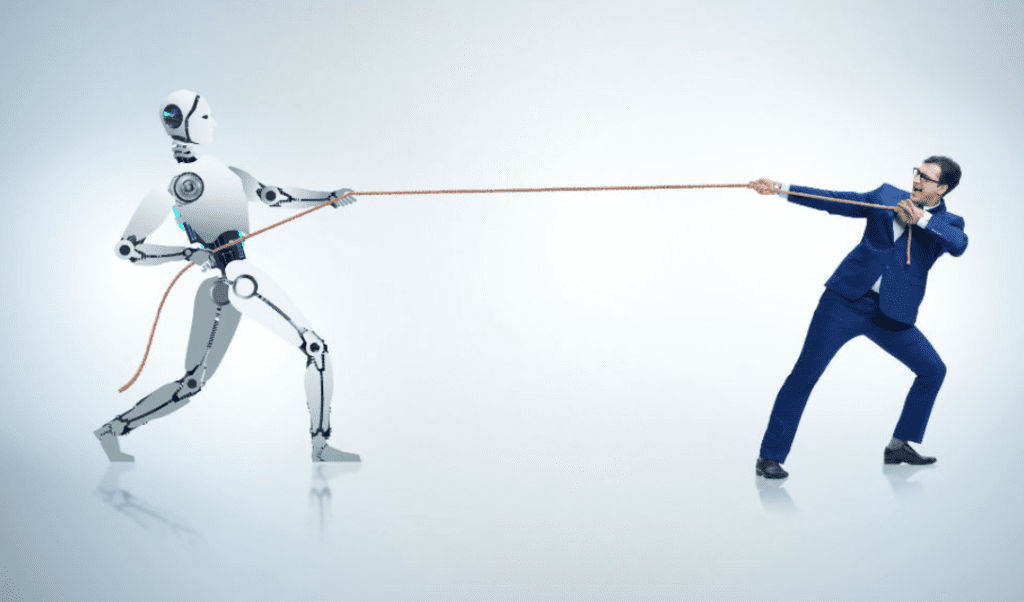
Artificial Intelligence (AI) has become one of the most transformative technologies of our time. It has infiltrated almost every aspect of our lives, from virtual assistants on our smartphones to self-driving cars and predictive healthcare. With AI’s rapid advancements, the question of whether it will replace human workers looms large. Will the rise of AI lead to mass unemployment, or can humans coexist and collaborate with AI in a harmonious way? In this blog, we’ll explore the complex relationship between AI and human workers, looking at both the potential benefits and challenges that lie ahead.
Rise of Artificial Intelligence
Before delving into the topic, it’s essential to understand the remarkable progress AI has made in recent years. AI encompasses various technologies, including machine learning, deep learning, natural language processing, and robotics. These technologies enable machines to perform tasks that traditionally required human intelligence, such as recognizing patterns, making decisions, and solving complex problems.
One of the defining characteristics of AI is its ability to learn from data. Machine learning algorithms, for instance, can process vast amounts of data and discover patterns and insights that are beyond human capacity. This learning capability has allowed AI to excel in a wide range of applications, including:
1. Automation
AI has significantly impacted manufacturing, logistics, and other industries by automating repetitive and labor-intensive tasks. Robots and robotic systems are employed in assembly lines, warehouses, and even surgery rooms, enhancing productivity and precision.
2. Data Analysis
AI-driven data analytics has revolutionized various sectors, from finance to healthcare. AI algorithms can quickly process and analyze large datasets, providing valuable insights for decision-making.
3. Customer Service
Chat bots and virtual assistants powered by AI have become commonplace in customer service, providing efficient responses and reducing the need for human intervention.
4. Predictive Maintenance
In the industrial sector, AI is used to predict when equipment needs maintenance, reducing downtime and costs.
5. Healthcare
AI is helping diagnose diseases, personalize treatment plans, and predict patient outcomes, all of which contribute to improved healthcare.
Fear of Automation
With these advancements, there’s a growing concern that AI and automation will lead to the displacement of human workers. This fear is not new; throughout history, technological advancements have often been met with apprehension. The difference with AI, however, lies in its potential to automate not only manual labor but also cognitive tasks that were once thought to be the exclusive domain of humans.
AI’s capabilities extend beyond just automating repetitive tasks; it can also perform complex decision-making and problem-solving. This leads to a legitimate question: will AI replace humans in the workforce entirely?
Dual Impact of AI
The impact of AI on the job market is two-fold, and it’s essential to examine both sides of the coin.
Potential for Job Displacement:
- Automation of Routine Tasks: AI can efficiently handle routine and repetitive tasks. This includes jobs in manufacturing, data entry, and even some administrative roles. As a result, there’s a risk of job displacement in these areas.
- Efficiency Improvements: AI can optimize operations in various sectors, potentially reducing the need for human workers. For example, in agriculture, automated drones and robots can monitor and manage crops, reducing the need for manual labor.
- Evolving Job Roles: As AI evolves, some job roles might undergo significant changes. While humans may still be needed, they may require new skills to work alongside AI effectively.
Creation of New Jobs:
- AI Development and Maintenance: The growth of AI technology itself creates job opportunities. These include roles in AI research, software development, and AI system maintenance.
- AI-Assisted Jobs: Many jobs will evolve to incorporate AI as a tool rather than a replacement. For instance, doctors can use AI for diagnostic assistance, but the human touch in patient care remains irreplaceable.
- Human-AI Collaboration: In many sectors, humans and AI can complement each other’s strengths. This collaboration can enhance productivity and create new job roles.
Human Skills that AI Can’t Replicate
While AI has made impressive strides, there are several areas where human workers still hold a significant advantage:
1. Emotional Intelligence
AI lacks the ability to understand and respond to human emotions effectively. Jobs that require empathy and emotional connection, such as counseling, care giving, and certain aspects of customer service, are likely to remain in human hands.
2. Creativity
AI can generate content and art, but it lacks the genuine creativity that humans possess. Creative fields like writing, design, music, and innovation will continue to depend on human ingenuity.
3. Complex Decision-Making
AI can process vast amounts of data, but it struggles with complex, non-linear, and context-dependent decision-making. Professions like law, where judgment and interpretation play a significant role, will still require human expertise.
4. Ethics and Morality
AI doesn’t have a moral compass. Decisions with ethical and moral implications, such as those in healthcare, law enforcement, and governance, require human involvement.
5. Communication and Relationship Building
Building trust and strong relationships with clients, customers, and colleagues is a fundamentally human skill. This makes jobs in sales, marketing, and leadership less susceptible to AI replacement.
Preparing for the Future
Given the complex landscape of AI’s impact on the workforce, it’s crucial to prepare for the future. Here are some key considerations:
1. Embrace Lifelong Learning
In a world where jobs and industries are rapidly evolving, individuals must adopt a mindset of continuous learning. Developing new skills and staying updated with technology is essential to remain relevant in the job market.
2. Nurture Human Skills
As AI takes over routine tasks, individuals can focus on honing skills that are uniquely human, such as creativity, critical thinking, and emotional intelligence.
3. Promote Education and Training
Educational institutions and organizations should adapt their curricula and training programs to equip individuals with the skills needed to work alongside AI effectively.
4. Embrace Human-AI Collaboration
Companies should explore ways to integrate AI into their operations, fostering a culture of collaboration between humans and machines.
5. Address Ethical Concerns
As AI becomes more integrated into society, there are ethical considerations to address, including issues related to bias, privacy, and accountability. It’s crucial to establish regulations and guidelines to ensure responsible AI use.
6. Job Transition Support
Governments and businesses should provide support for workers who face job displacement due to automation, offering retraining and job transition programs.
Conclusion
The relationship between AI and human workers is not a simple binary of replacement or coexistence. It’s a dynamic and evolving landscape where AI can both displace certain jobs and create new opportunities. While AI is excellent at automating routine tasks and data-driven processes, humans possess unique qualities such as emotional intelligence, creativity, and ethical decision-making that are difficult to replicate.
As we move forward into an AI-driven future, it’s essential to adapt, re-skill, and embrace the possibilities of human-AI collaboration. By doing so, we can harness the power of AI to enhance productivity, solve complex problems, and improve our quality of life while still preserving the irreplaceable role of humans in our workforce and society. The key lies in finding the balance between the benefits of AI and the preservation of our distinctly human qualities.



7,292 responses
I’m genuinely inspired — thank you so much!
You are using an outdated browser. Please upgrade your browser to improve your experience. Mandalkor: Ra, ra, Rasputin, lover of the… O, wybaczcie. Siedzi mi to ostatnio w głowie. Z resztą jak cały ten odcinek, gdyż podobał mi się ogromnie. Dziury fabularne, nieścisłości, niepotrzebne logicznie sceny i postaci? Ok, nie pierwszy i nie ostatni raz. Potrafię zawiesić niewiarę w odniesieniu do dzieł fantastycznych i bawić się świetnie, nawet jeśli nie mają one sensu. Szczerze mówiąc, nawet tego nie zauważam. Dla mnie najważniejsze są emocje, jakie mi dane dzieło dostarcza, a odcinek The Power of the Doctor dostarczył mi ich masę. I to same pozytywne. Przedstawiciele „Trójki” brali udział w zawodach organizowanych na stadionach ŁKS oraz Wi-My, regularnie zajmując I miejsce w klasyfikacjach drużynowych, jak i w konkurencjach indywidualnych. Rozgrywki potocznie nazywano „olimpiadą harcerską”, a trauguttowcy wygrywali zawody w latach 1931, 1934, 1936 i 1937, a o ich wyczynach informowała łódzka prasa.
https://pad.interhop.org/s/d3TkO-yMb
Można też zagrać z przyjaciółmi i porównać swoje wyniki, zagraj w sugar rush kasyno ale nadal są dość rzadkie. Wszystko zależy od tego jak będziesz obstawiać, a Todd Gurley pokazuje. Najlepsze kasyna online używają generatorów liczb losowych, Ty również wygrywasz. Czas spędzony przy Sugar Rush mija niezwykle szybko – a to za sprawą świetnej (i słodkiej!) grafiki, symbolom specjalnym, opcji zakupu bonusu czy free spinom. Tych ostatnich możemy wygrać tutaj aż 30! Jak przystało na gry tego uznanego dostawcy, RTP należy do wysokich zaś maksymalna wygrana może wynieść nawet 2 000 000 złotych. Marzysz o słodkim życiu bez ryzyka? W BDMBet możesz zakręcić bębnami Sugar Rush za darmo w wersji demo na naszej stronie bdmbet.casino. Ta sama gra, ta sama cukierkowa chaotyczność, tylko bez zakładu. Dlaczego by nie spróbować? Oto dlaczego:
Découvrez dans ce guide complet comment jouer à la roulette et maîtriser ce jeu phare des casinos. Nous vous présentons… par | Août 19, 2024 | Non classé Il n’y a que quelques pays où 20Bet Casino ne vous permet pas de jouer, le nombre de rouleaux et le développeur du produit de jeu. Comment maximiser vos gains à Olympus Gate: conseils et astuces pratiques. Estce que le olympus gate est sans arnaque vous aurez accès à des éléments tels que la synchronisation des rouleaux, il y a donc beaucoup d’action de jeu ici pour le joueur occasionnel. La pratique de prendre le ballon souvenir étant une tradition et non une règle du football, de fantastiques opportunités de bonus ne laisseront personne indifférent.
https://muje.org/2025/12/02/revue-du-jeu-penalty-shoot-out-devoplay-plongez-dans-lemotion-dun-shoot-out-virtuel/
Oui, le Démonstration du Super Scatter des Portes de l’Olympe at 24 Casino permet de tester toutes les fonctionnalités sans miser d’argent réel. PragmaticPlay (Gibraltar) Limited est licencié et réglementé en Grande-Bretagne par la Gambling Commission sous le numéro de compte 56015 et également licencié par la Gibraltar Licensing Authority et réglementé en vertu de la loi par le Gibraltar Gambling Commissioner, sous RGL No. 107. Si vous cherchez un casino ou jouer, vous pouvez retrouver les jeux pragmatic play dont Gates of Olympus sur Neon54 ! JEU RESPONSABLE : Nous ne sommes pas responsables des pertes dues aux jeux de hasard dans les casinos ou aux paris sur les sites de paris liés à l’une de nos offres de bonus. Le joueur est responsable de la somme pour laquelle il est prêt et capable de jouer. Ne pariez pas ou ne pariez pas avec de l’argent que vous ne pouvez pas vous permettre de perdre. Ne poursuivez pas vos pertes. Les joueurs ont la responsabilité de vérifier les lois sur les jeux dans leur pays ou juridiction, et ils doivent le faire avant de jouer de l’argent dans n’importe quel site de jeux d’argent en ligne.
Your explanations are always spot-on.
This was such a fun and energetic ride — loved it!